
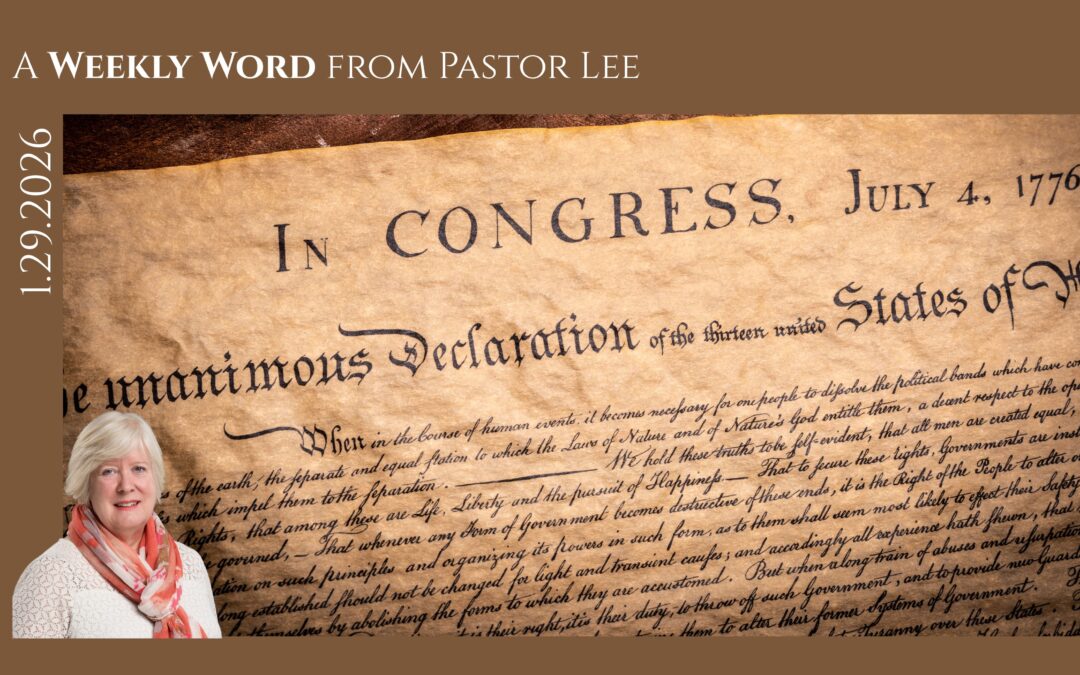
I mentioned a book during my Message on Sunday, but I want to tell you the rest of the story. The book was Our Declaration: A Reading of the Declaration of Independence in Defense of Equality. It’s by Danielle Allen, a professor of government at Harvard and a political theorist.
This book was part of the inspiration for our We the People worship series. It makes me prouder than I already was to be part of this nation—which was founded on a commitment to equality that I didn’t already really know. I am inspired by this book. I hope you will be, too.
The rest of the story is that I got to hear this author, Danielle Allen, lecture at ISU in October. Her talk was titled “Do Words Matter? The Language of Liberty in the Declaration of Independence.” ISU doesn’t keep lecture recordings on its website more than a few weeks, so I can’t send you the link. But I do commend the book. And I want to share a couple of things about it.
First, as I listened to Danielle Allen talk with great specificity about some of the 1500 words of the Declaration of Independence, turning over phrases in various ways, and considering the context or then-contemporary use of certain terminology, I thought, “Wow. This is like listening to a Biblical scholar talk about a passage from Scripture.”
As an English major in college, and having been a lawyer and then attending seminary, I’ve watched scholars dive deep into words that were written decades, or centuries ago—and I’ve been such a scholar at times. It was stunning to me to hear Allen pause over the Declaration’s words with such care and intimacy.
Most of us hardly know these words. Well, most of us know what we think are the key phrases—”that all men are created equal, that they are endowed by their Creator with certain unalienable Rights, that among these are Life, Liberty and the pursuit of Happiness.” (I’d wager, though, that many of us could recite the first and last of those phrases but not the middle one!)
Danielle Allen reports an unscientific survey that revealed that probably less than half of even college-educated Americans have read the entire Declaration. Presumably that number would be even smaller if we were relying just on primary and secondary education.
In elementary school I memorized the Gettysburg Address. (I can still say much of it!) I think that—until I read Allen’s book—I was among that half that hadn’t really ever read the entire Declaration, word by word.
Allen developed her love of the Declaration out of her role as a teacher, long ago, when she was a professor at the University of Chicago. And her transformation came not so much from teaching (as she describes them) her “bright-eyed undergraduates” but a group of night students who were, she says,
without jobs or working two jobs or stuck in dead-end part-time jobs, while nearly always also juggling children’s school schedules, undependable daycare arrangements, and a snarled city bus service. They should have seemed bone tired when they arrived at class, but they pulsed with energy. (Allen, p. 31, 33)
Without very high expectations, Allen started including the Declaration as part of the reading assignment for these night students. And she was amazed at how this old writing which seemed not to belong to them began to transform them. Reading it closely, word by word, and thinking through the arguments the Declaration makes, they began to understand its case for political equality. For a democracy that “empowers each and all,” without domination by one over others. (p. 34)
As they read and learned, these night students began to see themselves differently. They began to imagine themselves “as political beings, with a consciousness that had previously eluded them. They built a foundation from which to assess the state of their political world.” (p. 35)
This weekend we’ll hear Jesus’ words to people not so different from those night students. Those who were hurting, poor, meek. Jesus words in Matthew 5 did something for them that the Declaration is intended to do, too.
What if all of us tired, us poor—all the huddled masses yearning to breathe free—what if we could begin to grasp the deep, shining truth not just of God’s care and intentions for each and every one of us, but also of the power of reimagining our political relations that mirror all of that? It’s what we were founded on. It’s what we’re talking about in this season.
I hope you’ll check out the book, and join on these Sundays. Maybe we can be inspired together.