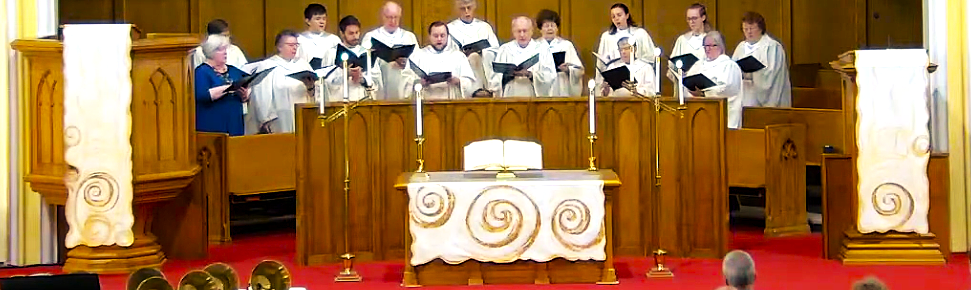
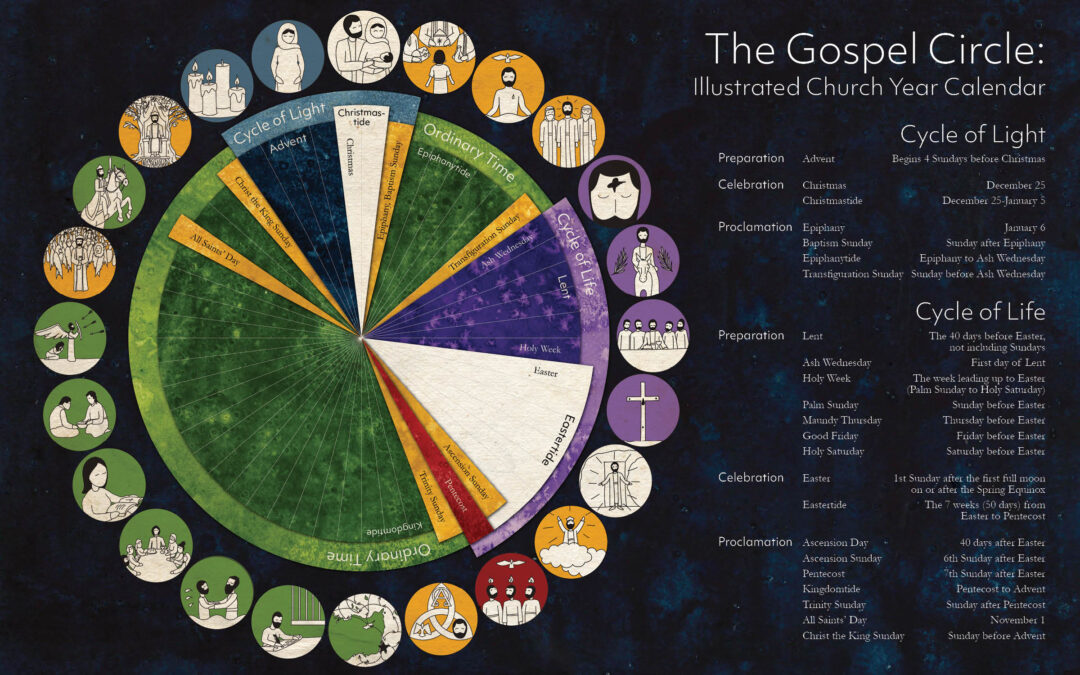
If you joined us for worship on January 11, you got a firsthand look at our new worship textiles–“paraments”–and you got to be part of their consecration. Our Worship Cluster has worked hard over the past year to make this dream a reality, and we wanted to make the pictures and stories of these pieces of art available to all. Take a look! You’ll be glad you did.
___________________________________________________
In 2024, Collegiate/Wesley’s Worship Cluster submitted an application to our church’s Endowment Board for funds toward what we’ve termed “The Parament Project.” We wanted to curate a collection of liturgical textiles that spanned the full Christian year. “Paraments” are the textiles and banners that adorn our altar, lectern, and pulpit every Sunday. The Christian year takes us every year through a number of holy days and seasons, each with its own theme and colors.
The stated goal of the Parament Project was “to supplement our existing collection of commissioned textiles and replace some of the mass-produced [ones] that needed to be retired.” Worship Cluster worked with a range of creators here in the Midwest, and ultimately commissioned five unique sets of textiles that span the liturgical year. On Sunday, January 11, 2026, we consecrated these new acquisitions and celebrated the Christian year. Here, we share and summarize the artist and design notes.
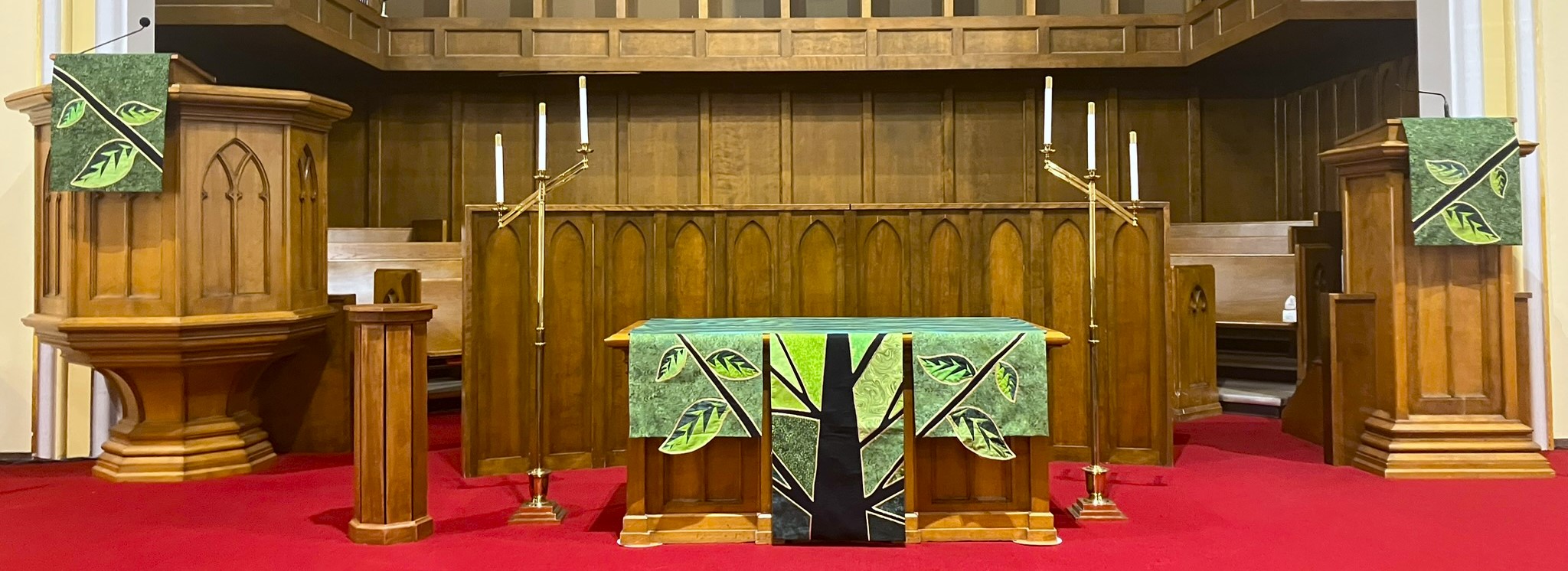
Ordinary Time – Green
Artist: Rev. Melanie Hauser – Stitches and Sparks (Storm Lake, IA)
Green is for what we call “Ordinary Time.” That word “ordinary” doesn’t mean typical, or normal, or usual. The name “Ordinary Time” is connected to the idea of “ordinal” numbers–the ordering of numbers in a sequence, counting 1, 2, 3 and so on. The Christian year includes Ordinary Time during two periods–the five to seven weeks between Epiphany and Lent, and the several months from Pentecost until Advent, roughly June through November.
We commissioned our paraments for Ordinary Time from Melanie Hauser, who joined us in worship last summer when she was part of our “Believing Out Loud” series. Melanie is a recently ordained United Methodist elder and serves fulltime as chaplain at Buena Vista University in Storm Lake, where she was previously a chemistry professor. She was inspired by the image of the Tree of Life when creating these textiles. You can see how her design extends the Tree of Life across the full altar space. Although she has worked for years in quilting and other textile arts, this was her first formally commissioned work. She hopes to expand this artistry through her newly-created textile website, Stitches and Sparks.
Lent – Purple
Artist: Anne Anderson – Interwoven Studio (Forest City, IA)
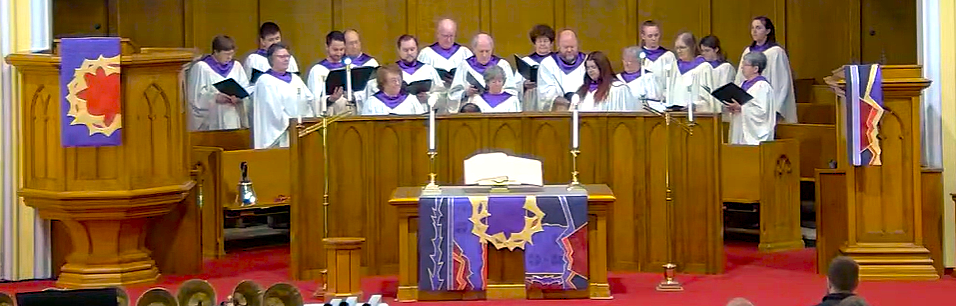
Lent is the period of 40 days, not counting Sundays, that starts with Ash Wednesday and leads us into Holy Week and Easter. The basic color for Lent is purple.
This set of paraments was created by Anne Anderson, who owns Interwoven Studio in Forest City, Iowa. Anne’s designs are typically built around a central theme, and she uses shapes and colors that allow each viewer to find a different meaning in the piece. She created these textiles around the image of the Crown of Thorns, with different shades of purple and red that evoke the passion of the Christ.
Pride – Rainbow
Artist: Grace Cox-Johnson – Color for the Journey (Kansas City, MI)
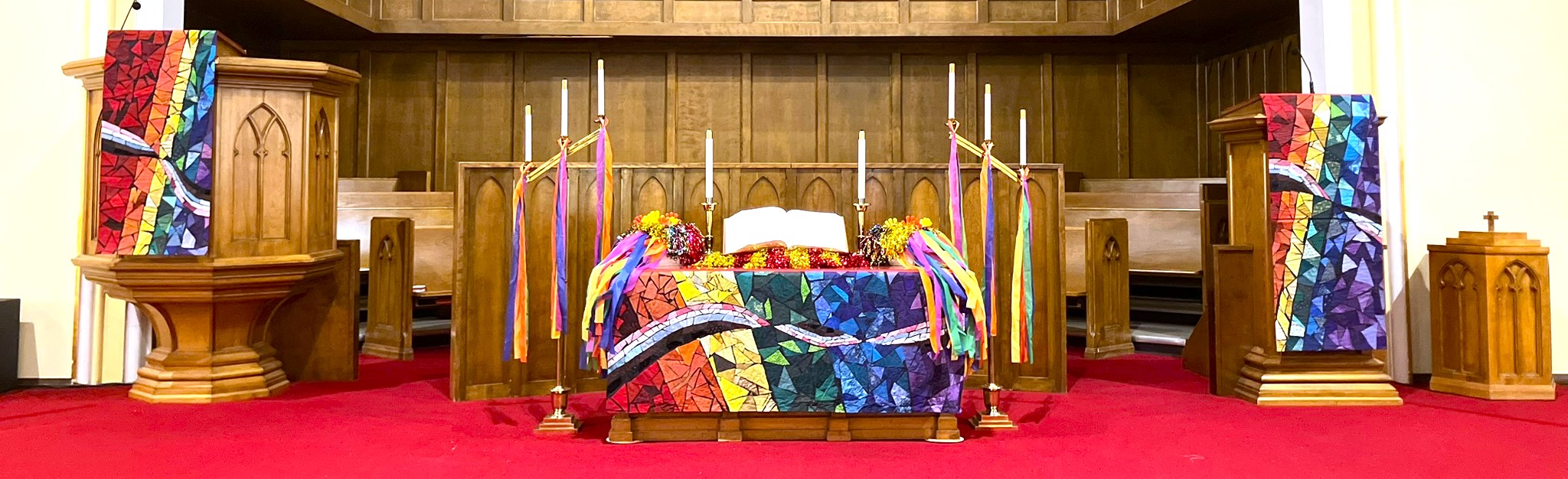
You won’t find “rainbow” or “Pride” on any calendar of the Christian Year, but as a church that has long expressed its commitment to welcoming all, including persons who celebrate Pride Month in June, we have often used rainbows as part of our worship during that time.
In developing the Parament Project, we knew this needed to be included. Our own Fred Lewis introduced us to Grace Cox-Johnson, who created and leads Color for the Journey in Kansas City, Missouri. Grace suggested that we create these paraments in a collaborative fashion–which you may remember happened last fall. Thank you, again, to all who joined us to put these together.
We used these paraments for the first time at our October service that celebrated the 25th anniversary of Collegiate/ Wesley’s adoption of its Reconciling Statement. We are grateful for Grace helping us to create these fabric mosaics to serve as a special reminder of our church’s mission and commitment.
Advent – Blue
Artist: Jeff Wunrow – Jeff Wunrow Designs (St. Louis, MI)
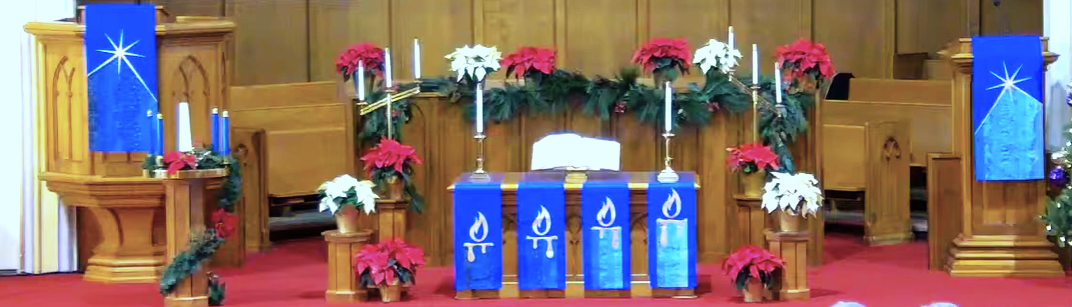
Of all the seasons of the Christian Year, you may be most familiar with Advent–the period of four Sundays that leads us to Christmas. The color for Advent can be purple or blue; our church has traditionally chosen blue and we stayed with that practice in the design of our new Advent paraments.
These were created by Jeff Wunrow, owner of Jeff Wunrow Designs in St. Louis. He designed these paraments around the theme of light and the advent wreath. The two flanking stars anchor the advent candles that progress in height and color as the altar parament pieces get added through the Advent season.
Sundays after Christmas and Easter – White
Artist: Chillon Leach – Chillon Leach (St. Paul, MN)
White (with gold) is the liturgical color for the Sundays after Easter and for the Sundays after Christmas. White is also the color for the start or end of other seasons, and for holy days like All Saints Day that fall within a season. We also generally use white paraments for funerals, and sometimes on Communion Sundays, no matter what the season is.
These paraments were designed in consultation with Chillon Leach, a liturgical textile artist in St. Paul, Minnesota. She aimed to represent the Holy Trinity with the three whorls on the altar parament, and the gifts of the spirit, represented by the seven whorls across the lectern and pulpit paraments.